I’ve been sewing for just over two years now, and I’m noticing the result of spending all my money on fabric rather than RTW clothing is that a few specific items are beginning to look a little… threadbare.
I wear button-up shirts to work during the week – they add a little professionalism to my uniform of jeans, steel-caps and hi-vis.
But when I started working in an office environment, it seemed ludicrously expensive to pull together an appropriate wardrobe – a really good quality shirt starts at $170+, and I’m too fussy to have just bought standard high street fare (which falls apart after 6 months of wear anyway). So to bridge the gap between my french champagne taste and my cask wine budget, I turned to second hand. I tried top-end shirts on in shops and then scoured eBay like a hungry hawk, and over-time ended up with a fairly substantial collection of silk and cotton shirts for a fraction of the cost – many of which I’m still regularly wearing today 4 years down the track.
At one point I did splurge though – I had a shirt made to measure when I noticed in their shopfront they were having a rather rare half-price deal. It was a really cool experience – I got measured up in store (there was 14+ measurements taken), then I went back for a fitting a few weeks later once it had been made before finally getting to take it home a month later. I was a little unhappy with it at first, because it seemed so much bigger, but after wearing it once or twice, I was in love. It made me realise exactly what I’d been putting up with by wearing standard sized fare – not only was it extremely comfortable, but I had a full range of movement without having to worry about that front button popping open, or having the button placket strain to give the person next to me an eye-full of whatever bra I was wearing that day.
That shirt has been in retirement for some time now, and I’m thinking I’ll probably cut it up and use it as a pattern base at some point. But for the meantime, I’ve been using it to adjust the McCalls OOP pattern I’m using to sew up my first collared shirt – 5929.
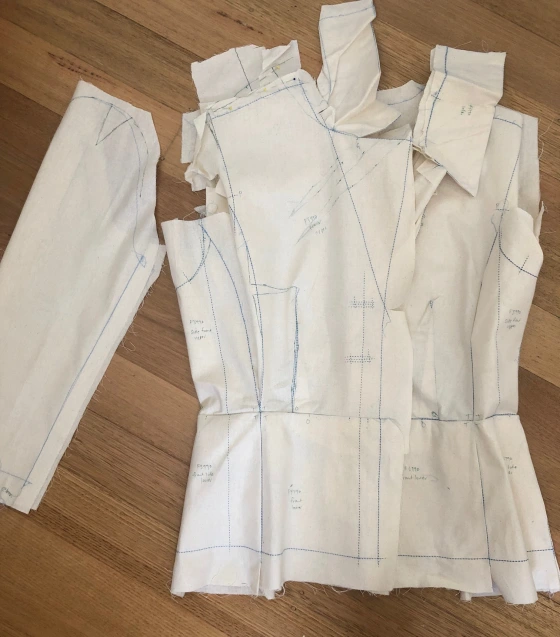
Copying my made-to-measure shirt to get the darts in the right place worked a treat, the fit through the front is great, if a little tighter fitting that I would like – which is easily fixed. I’m planning to make this out of a lightweight silk/cotton voile blend – a bit different to the starched calico I’m using to test the fit. Most of the strain is around my hips and at the tops of the side seams next to my bust:
However, at the back – apart from it being more obvious here to me that it was a little tight – there was that annoying pooling of fabric around my waist, which I’d already pinched out and sewn up (about 3cm all up), tapering to nothing the side seams and perpendicular to the grain line:
I thought for comparison, I’d whack on my made-to-measure shirt to compare – here’s the front and back:
Once I’d transferred the swayback adjustment to my pattern piece, I realised that as my shirt doesn’t have a centreback seam (I also don’t WANT it to have a centreback seam) that I couldn’t just leave it as is – the ‘cut on the fold’ edge was no longer straight:
After a bit of reading and googling, and then reading and googling some more, I decided to try two different methods at adjusting my pattern. I felt like I had some time to kill whilst I waited for a particular Marfy pattern to arrive in the mail – at which point this project would be dropped like the hottest of hot potatoes to work on that.
First up - this method at swayback adjustment (from Fitting and Pattern Alternation (1992) by Liechty, Pottberg, & Rasband, pages 140-143) which resulted in a very square shoulder seam:
Sewn up and attached:
There’s still some pooling (ignore the tightness, I’d yet to attack that), but at this point I’m wondering if it is even logistically possible to get rid of this and still not have a centre-back seam. And I’d probably want to soften the squareness of the shoulder seam as well.
Ok, so let’s try method number 2 for comparison – I’m taking this from Sherry’s (Pattern Scissors Cloth) blog, she did an amazing post on altering for a sway back way back in 2010. I’ll admit, I fumbled around with this method for several days trying to figure out both how it worked and why, even testing it on mini-pattern pieces to get my head around it.
In the end, I just didn’t get the logic of it. I attribute that to the fact that Mr poppykettle and I are smack bang in the middle of the Live Below the Line challenge, and I am SO DAMN HUNGRY right now that I swear my brain isn’t functioning properly.
So I step back and try to think coherently.
I vaguely (very vaguely) remember reading somewhere that when fitting, you should always work top to bottom. And then a mini lightbulb moment… and all of a sudden it makes complete sense. If I add in the extra width at the sides, then the fabric pooling will be reduced – surely. I’ve been reading KathleenS’s PR Review of Simplicity 2339 (she was the runner up in PR’s Fitted Blouse contest in March this year) and staring intently at her flickr photos and I’m nigh-on convinced this will solve it.
Thoughts?